Complex Roots Theorem. To understand the theorem better, let us take an example of a polynomial with complex roots. De moivre’s theorem states that the power of a complex number in polar form is equal to raising the modulus to the same power and multiplying the argument by the same power.
PPT Rational Root and Complex Conjugates Theorem from www.slideserve.com
Conjugate roots theorem we have that is a polynomial with complex coefficients. 5 roots will be `72°` apart etc. That is, 2 roots will be `180°` apart.
If The Theorem Finds No Zeros, The Polynomial Has No Rational Roots.
In this section we discuss the solution to homogeneous, linear, second order differential equations, ay'' + by' + c = 0, in which the roots of the characteristic polynomial, ar^2 + br + c = 0, are complex roots. The fundamental theorem of algebra tells us that a polynomial of degree 𝑛 will have, when counted with multiplicity, 𝑛 roots. Conjugate roots theorem we have that is a polynomial with complex coefficients.
Where Is A Complex Number And N Is A Positive Integer, The Application Of This Theorem, Nth Roots, And Roots Of Unity, As Well As Related Topics Such As Euler’s Formula:
4 roots will be `90°` apart. This research will provide a greater understanding of the deeper This root is known as the principal nth root of z.
Where K = 0, 1, 2,., (N − 1) If K = 0, This Formula Reduces To.
Then the nth roots are given by. Since complex roots come in conjugate pairs, there are an even number of them; The roots lie on a circle of radius jzjcentred at the origin and spaced out evenly by angles of 2ˇ=n.
A) All The Third Roots Of.
Furthermore, since a quadratic equation only has two roots, 𝑐 + 𝑑 𝑖 must be the conjugate of 𝑎 + 𝑏 𝑖. Because of the fundamental theorem of algebra, you will always have two different square roots for a given number. De moivre's theorem to find roots of complex numbers.
This Just Means That It’s Roots Are Complex, And Involve Some Irrational Operator, Like A Radical, E, Π, Etc.
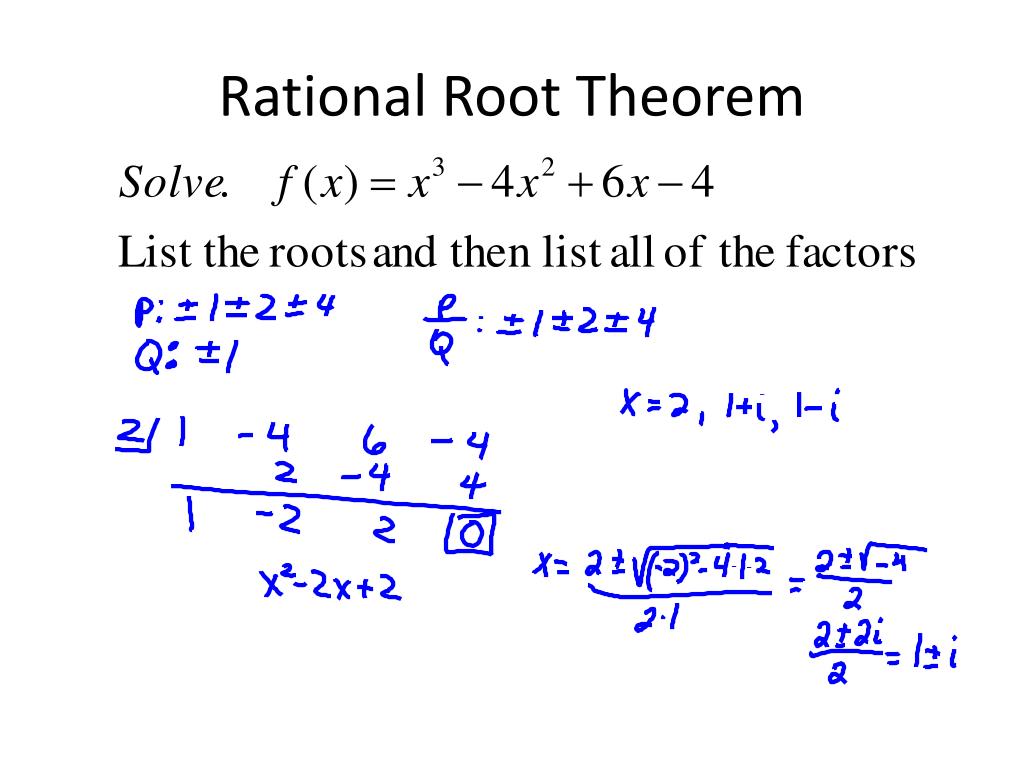
3 roots will be `120°` apart. If z is a complex number of the form. Using the complex conjugate root theorem, find all of the remaining zeros (the roots) of each of the following polynomial functions and write each polynomial in root factored form :