875 As A Fraction Of An Inch. If you have the length in cm, divide the result by 2.54. .875 1 multiply both numerator and denominator by 1000 (because there are 3 digits after the decimal point so that is 10 3 = 1000).
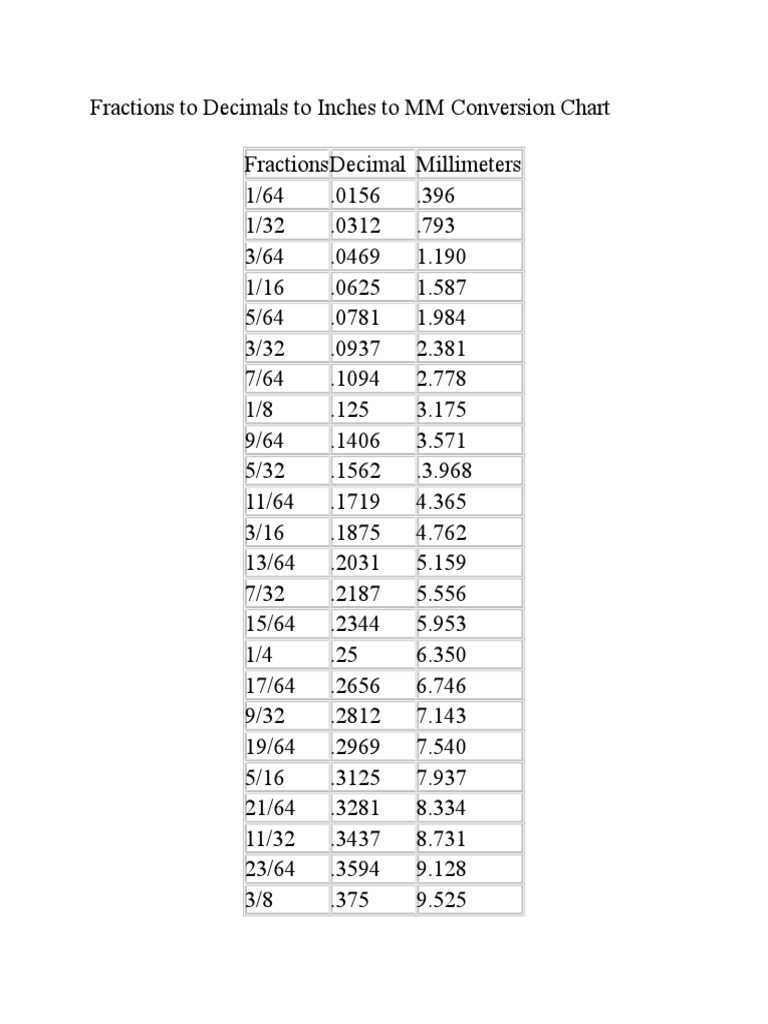
Inch Fractions to Decimals to Inches to MM Conversion Chart 1 from www.scribd.com
There are 25.4 millimetres in one inch. 0.875 as a fraction equals 875/1000 or 7/8 steps to convert 0.875 into a fraction. If you counted in 1/4 inches on a ruler, you’d see that the fourth line after 0 inches equals 1/4 inch, the eighth line equals 2/4 (1/2) inch, and the 12th line equals 3/4 inch.
Therefore, Rounded To Two Decimal Places, 875 Millimetres Is Equal To 875/25.4 = 34.45 Inches.
If you have the length in mm, divide the result by 25.4. To determine this, take 875/1000, and reduce the fraction as much as possible. The original hose is listed as.875 inch id.
.875 1 Multiply Both Numerator And Denominator By 1000 (Because There Are 3 Digits After The Decimal Point So That Is 10 3 = 1000).
The first thing you need to do to convert your decimal point to its. 1.875 =~ 2 (if you admit an error of 6.666667%) sample decimal to fraction conversions 0.777777 decimal to fraction The 1/8 of an inch marks are the smaller marks discovered immediately in between the 1 /4 of an inch marks on the ruler.
As With Our Earlier Problem, It Turns Out That We Can Reduce This Fraction To Lowest Terms By Dividing Its Numerator And Denominator By 125.
65 rows inch fractions to the 1/64 of an inch and the equivalent decimal values in inches and metric values in millimeters; The greatest common factor of 875 and 1000 is 125, which means you can divide the numerator and denominator by 125 and keep the same value: Furthermore, what is 3/16 of an inch on a tape measure?
7.875 In Fraction Form Is 63/8.
0.875 inches in fraction or what is 0.875 as a fraction. Accordingly, what does 1/8 appear to be on a ruler? Between 0 and 1 inch, there are marks that denote 1/8, 1/4 (or 2/8), 3/8, 1/2 (or 4/8), 5/8, 6/8 (or 3/4), 7/8, and 1 (or.
You Can Take Any Number, Such As 4.875, And Write A 1 As The Denominator To Make It A Fraction And Keep The Same Value, Like This:
4.875 / 1 to get rid of the decimal point in the numerator, we count the numbers after the decimal in 4.875, and multiply the numerator and denominator by 10 if it is 1 number, 100 if it is 2 numbers, 1000 if it is 3 numbers, and so on. You can take any number, such as 5.875, and write a 1 as the denominator to make it a fraction and keep the same value, like this: 5.875 / 1 to get rid of the decimal point in the numerator, we count the numbers after the decimal in 5.875, and multiply the numerator and denominator by 10 if it is 1 number, 100 if it is 2 numbers, 1000 if it is 3 numbers, and so on.