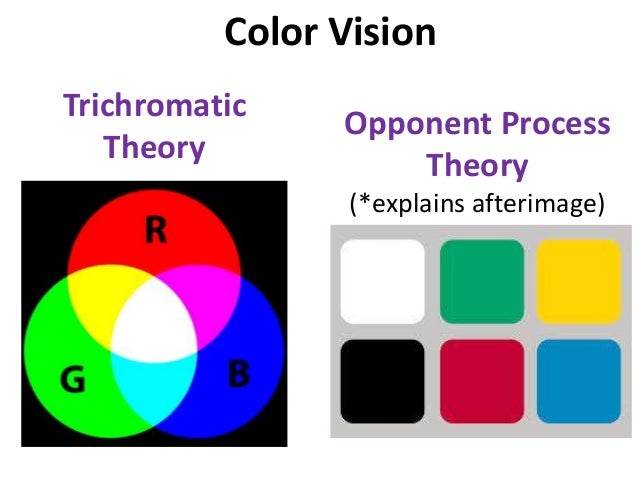
Trichromatic Theory Definition Psychology. The trichromatic color theory began in the 18th century, when thomas young proposed that color vision was a result of three different photoreceptor cells. To understand why some people are color blind, we need to consider the basics of color vision.
AP Psych Visual review from www.slideshare.net
Trichromatic theory of color vision psychology definition. Trichromatic theory two scientists, young and helmholtz, developed a theory that states all colors we see are combinations of three base colors. Psychology definition of trichromatic theory:
What Is The Trichromatic Theory In Psychology.
The cones are responsive to three different wavelengths that represent red, blue, and green. One is most sensitive to red, one is most sensitive to. Trichromatic theory of color vision the theory that there are three kinds of cones in the retina, each of which responds primarily to a specific range of wavelengths.
A Trusted Reference In The Field Of Psychology, Offering More Than 25,000 Clear And Authoritative Entries.
Hering disagreed with the leading theory of his time, known as the trivariance of vision theory or trichromatic theory, put forth by hermann von helmholtz. One of the more important empirical aspects of this theory is that it is possible to match all of the. These color receptors combine the colors to produce the perception of virtually any color.
Theory That The Retina Contains Three Different Color Receptors, (Red Blue And Green) Which Together Can Produce The Perception Of Any Color.
To understand why some people are color blind, we need to consider the basics of color vision. The theory that opposing retinal processes enable color vision. What is trichromatic theory ap psychology?
What Is Trichromatic Theory In Psychology?
Trichromatic theory of color vision. This theory suggested that color vision is based on three primary colors: Specialized receptors are sensitive to wavelengths associated with red, green, blue.
Helmholtz, Along With Thomas Young, Proposed The Trichromatic Theory, Or The Young Helmholtz Theory, That Stated That The Retina Contains Three Types Of Cones, Which Respond To Light Of Three Different Wavelengths, Corresponding To Red, Green, Or.
To understand why some people are color blind, we need to consider the basics of color vision. According to this theory, the human retina contains three different receptors for color (meaning each one is most sensitive to one color): Thomas young and hermann von helmholtz came up with a theory that the retina contains three different color receptors, hence rbg (red, blue, green).