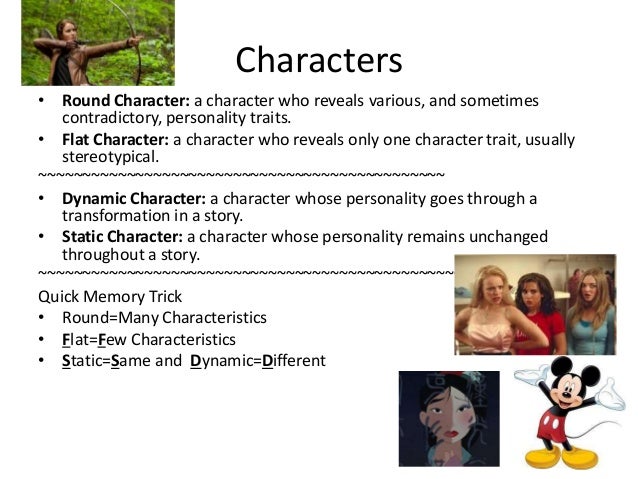
Flat Character Definition Literary Term. A foil is a literary character that is intended to highlight attributes in another character through opposing traits. Foster has discussed some features of flat characters in.
Short story literary terms power point from www.slideshare.net
A flat or static character is a character in a story that lacks depth and complexity, and tends to remain in a fixed mindset. They often do not learn anything from their experiences, or they are simply in the story to fulfill a role. Click here for spanish transcript).
For Example, Miss Havisham From Charles Dickens’s Novel Great Expectations, Is A Flat Character Who Seeks Only Revenge For Being Abandoned On Her Wedding Day.
These characters have many different traits, good and bad, making them more interesting. Flat characters are often said not to have any emotional depth. A stock character is a flat character that is instantly recognizable by readers.
A Flat Character Is A Type Of Character In Fiction That Does Not Change Too Much From The Start Of The Narrative To Its End.
Definition of a flat character. However, they highlight opposing traits. The characters are often something other than humans, or human characters may interact with nonhuman characters such as trolls, dragons, munchkins, kelpies, etc.
By Contrast, Round Characters Are Complex And Undergo Development, Sometimes Sufficiently To Surprise The Reader.
By contrast, round characters are complex figures with many different characteristics, that undergo development, sometimes sufficiently to surprise the reader. So if you would please leave a clear definition and an example. Is character double a term of the literary criticism,.
Foster Has Discussed Some Features Of Flat Characters In.
Flat character definition, an easily recognized character type in fiction who may not be fully delineated but is useful in carrying out some narrative purpose of the author. When we talk about flat characters and round characters, what we mean is that there is a difference — or some kind of distinction — between characters who are superficial, predictable, or otherwise not very. They can be captured by just a few words or by their “type”:
An Author Creates A Foil To Emphasize Traits In Another Character.
A flat character does not change during a story. On the other hand, a ‘round’ character is a complex character with many different characteristics and develops throughout the play or story and thus alters and can surprise the readers. In other words, a flat character has no depth.